
Description
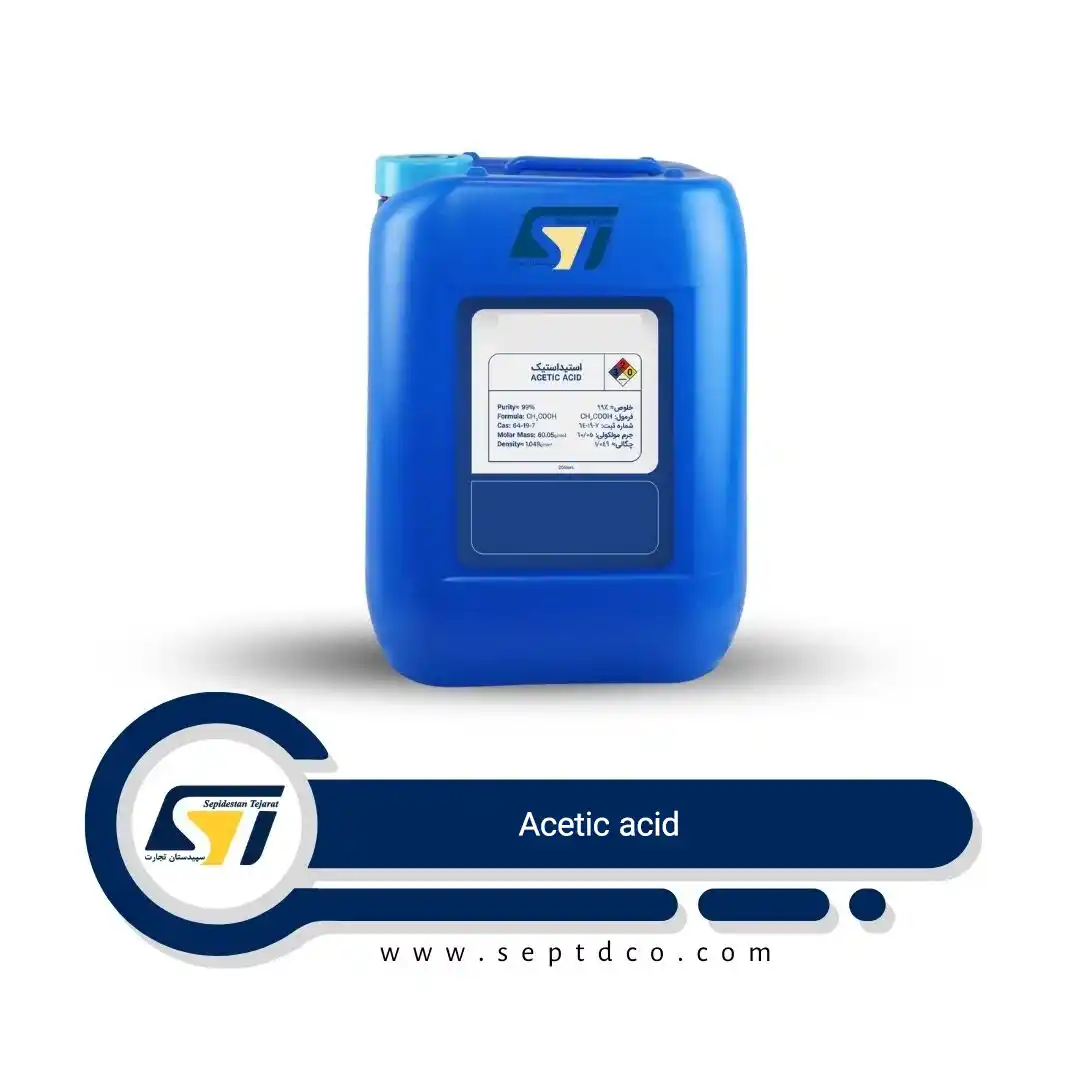
Acetic Acid (CH₃COOH) is one of the simplest and most important organic acids. This colorless liquid, recognized by its sharp vinegar-like odor, plays a vital role across numerous industries. It is the main component of vinegar and is widely used in food processing, plastics manufacturing, solvents, paints, pharmaceuticals, and many other chemical applications.
For purchasing high-quality Acetic Acid at competitive prices, contact the sales experts at Sepidestan Tejarat.
Technical Specifications
| Property | Description |
|---|---|
| Chemical Name | Acetic Acid |
| Chemical Formula | CH₃COOH |
| Appearance | Colorless liquid with a strong vinegar-like odor |
| Solubility | Completely soluble in water, alcohol, and ether |
| Food Applications | Acidity regulator in foods and beverages, vinegar production, preservative and flavoring agent |
| Industrial Applications | Production of acetates, plastics, solvents, pharmaceuticals, paints, and coatings |
| Physical / Chemical Properties | Weak organic acid, boiling point approx. 118°C, flammable, corrosive to metals and living tissues |
| Safety & Hazards | Direct contact may cause skin and eye burns; vapors may irritate the respiratory system; protective gloves and goggles are recommended |
Buying Acetic Acid
To purchase high-quality Acetic Acid with guaranteed authenticity, it is recommended to source from reputable chemical suppliers and import companies. These suppliers typically provide products that comply with international standards and offer a variety of packaging options.
Sepidestan Tejarat is one of the trusted suppliers of industrial chemicals in Iran, providing Acetic Acid with guaranteed quality, reliable packaging, technical consultation, and professional after-sales services.
Acetic Acid Supply by Sepidestan Tejarat
Sepidestan Tejarat is a leading distributor of high-quality chemical raw materials. With years of experience in the chemical industry, the company supplies Acetic Acid in different packaging formats and at competitive prices for industrial, pharmaceutical, food, and chemical applications.
The company guarantees high-quality products in accordance with international standards and provides fast delivery and technical support to customers throughout the country.
Available packaging:
- 65 kg drums and gallons
How is Acetic Acid Produced?
The most common industrial methods for producing Acetic Acid include:
- Oxidation of acetaldehyde
- Biological fermentation by bacteria
- Oxidation of ethanol
- Carbonylation of methanol using catalysts
Reaction of Acetic Acid with Methanol
In the presence of an acidic catalyst, Acetic Acid reacts with methanol to produce methyl acetate and water:
CH₃COOH + CH₃OH → CH₃COOCH₃ + H₂O
This reaction is known as esterification and is widely used in the production of:
- Fragrances
- Pharmaceuticals
- Industrial solvents
Ionization Reaction in Water
Acetic Acid is a weak acid and partially ionizes in water:
CH₃COOH ⇌ CH₃COO⁻ + H⁺
Its incomplete ionization is responsible for its mild acidic behavior.
Difference Between Acetic Acid and Formic Acid
Formic Acid (HCOOH) is the simplest carboxylic acid and differs significantly from Acetic Acid (CH₃COOH).
Formic Acid
- Stronger acid
- More corrosive
- Sharper odor
- Mainly used in textile and leather industries
Acetic Acid
- Milder acidity
- Widely used in food and chemical industries
- Commonly used as solvent and raw material
Applications of Acetic Acid
Acetic Acid is widely used in many industries and manufacturing processes.
Food Industry
- Vinegar production
- Food preservation
- Flavor enhancement
- Acidity regulation
Chemical Industry
- Production of esters and acetates
- Solvent manufacturing
- Chemical synthesis
Plastics & Polymer Industry
- Polyvinyl acetate (PVA) production
- Polymer and resin manufacturing
Paint & Printing Industry
- Production of inks and coatings
Pharmaceutical Industry
- Raw material for medicines and intermediates
Textile & Leather Industry
- pH adjustment
- Finishing and treatment processes
Cosmetics & Hygiene Products
- Due to antibacterial properties, used in some hygiene formulations
Is Acetic Acid the Same as Vinegar?
Vinegar is a diluted solution of Acetic Acid in water, usually containing about 4–8% Acetic Acid.
Pure Acetic Acid is much stronger and corrosive and is not directly used for food consumption without proper dilution and processing.
Acetic Acid Ionization Equation
CH₃COOH ⇌ CH₃COO⁻ + H⁺
This partial dissociation explains why Acetic Acid is considered a weak acid.
Frequently Asked Questions (FAQ)
1. What is Acetic Acid and what are its applications?
Acetic Acid is an organic acid mainly used in the production of esters, resins, plastics, solvents, and various chemical products. It is widely utilized in food, pharmaceutical, textile, and chemical industries.
2. How is Acetic Acid used in different industries?
It is used in:
- Pharmaceuticals
- Food processing
- Plastic manufacturing
- Textile production
- Paints and coatings
- Oil and gas processing
It also plays a role in pH adjustment and chemical synthesis.
3. What is the difference between industrial grade and food grade Acetic Acid?
Industrial grade Acetic Acid may contain impurities and is intended for chemical and industrial applications, while food grade Acetic Acid has higher purity standards suitable for food processing and consumption-related industries.
4. Is Acetic Acid dangerous?
At high concentrations, Acetic Acid can irritate the skin, eyes, and respiratory system. Proper safety equipment such as gloves, goggles, and ventilation should always be used during handling.
For purchasing Acetic Acid and other industrial or food-grade chemical raw materials, contact the sales department of Sepidestan Tejarat for updated prices, technical consultation, and product analysis documents.
Reviews
There are no reviews yet.