
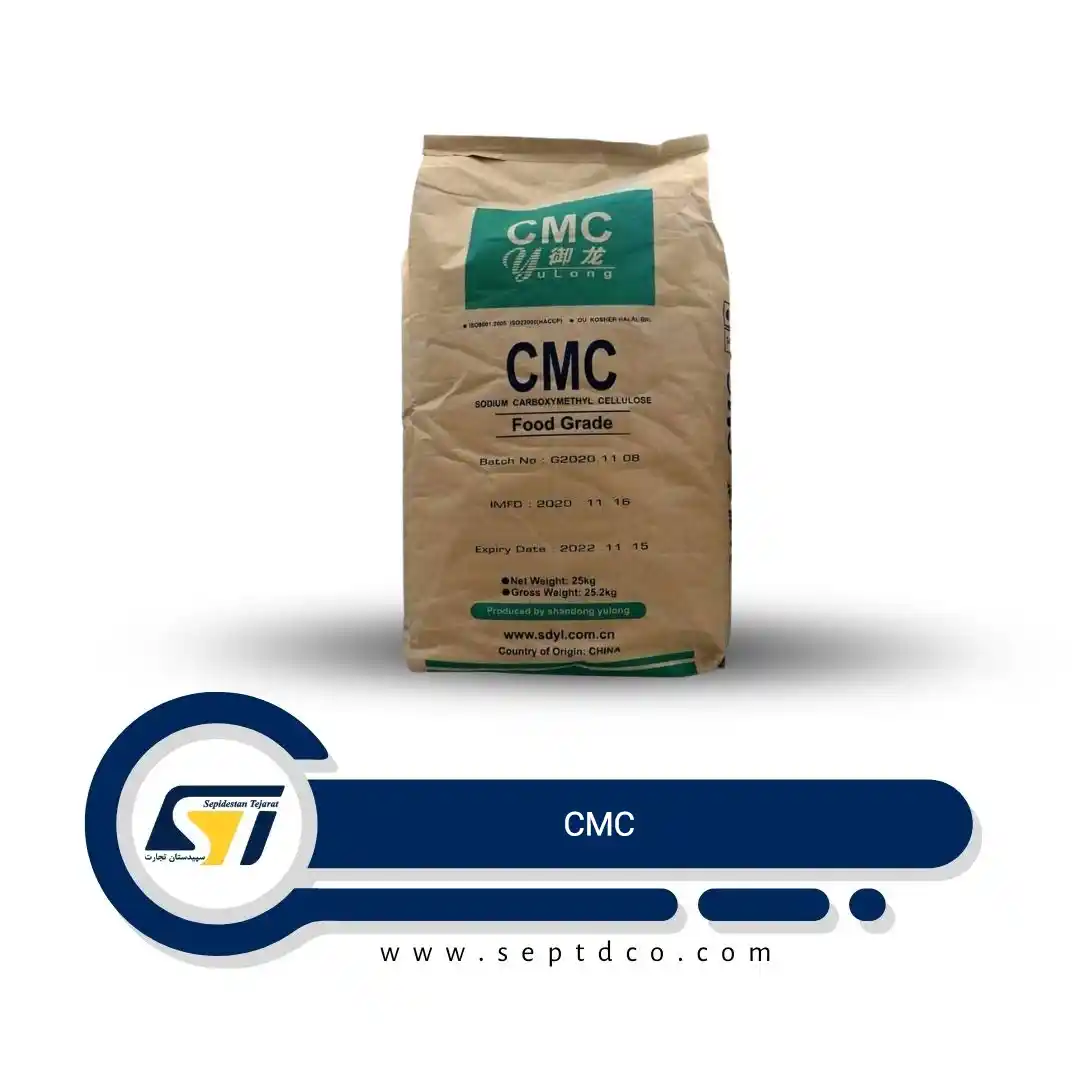
Description
Carboxymethyl Cellulose (CMC) is one of the most widely used chemical additives in food, pharmaceutical, cosmetic, detergent, and industrial applications. Due to its excellent thickening, stabilizing, water-retention, and texture-enhancing properties, CMC plays a critical role in modern industrial formulations.
Sepidestan Tejarat, with extensive experience in supplying chemical raw materials, offers high-quality food-grade and industrial-grade CMC along with professional technical consultation and reliable supply services for various industries.
Technical Specifications of CMC
| Specification | Food Grade CMC | Industrial Grade CMC |
|---|---|---|
| Chemical Name | Carboxymethyl Cellulose (CMC) | Carboxymethyl Cellulose (CMC) |
| Chemical Formula | (C₆H₇O₂(OH)₃₋ₓ(OCH₂COONa)ₓ)ₙ | (C₆H₇O₂(OH)₃₋ₓ(OCH₂COONa)ₓ)ₙ |
| Appearance | White to light cream powder, odorless | White to light cream powder, odorless |
| Solubility | Soluble in cold and hot water, forms viscous gel (dispersion may require proper mixing) | Soluble in cold and hot water with adjustable viscosity for industrial use |
| Applications | Thickener and stabilizer in beverages, ice cream, sauces, bakery products | Paper, textile, pharmaceutical, detergent, paint, oil drilling industries |
| Physical/Chemical Properties | Water-soluble polymer, high viscosity, stable at neutral pH | Water-soluble polymer with controllable viscosity and industrial stability |
| Safety | Non-toxic, food-safe, skin-safe | Non-toxic; inhalation of powder may cause mild respiratory irritation |
| Advantages | Improves texture and stability, increases viscosity | Controls viscosity, stabilizes formulations, suitable for harsh industrial conditions |
Food Grade and Industrial CMC Supply
Sepidestan Tejarat is a specialized supplier of high-quality CMC for both food and industrial applications. Customers benefit from:
- Fast delivery
- Guaranteed product authenticity
- Competitive pricing
- Technical support and formulation consultation
CMC Powder for Confectionery Applications
Food-grade CMC powder is widely used in confectionery and bakery products such as:
- Fondant
- Jelly products
- Stabilized whipped cream
- Decorative pastry formulations
Sepidestan Tejarat supplies confectionery-grade CMC in bulk packaging suitable for factories and workshops.
What is Food Grade CMC?
CMC is a multifunctional food additive commonly used as:
- Thickener
- Stabilizer
- Moisture retention agent
- Texture improver
It is colorless, tasteless, and highly effective even at low concentrations.
Applications of CMC in Food Products
| Product | Purpose | Typical Dosage |
|---|---|---|
| Yogurt & Ice Cream | Prevents whey separation, improves smooth texture | 0.1% – 0.5% |
| Beverages | Suspension stability, prevents sedimentation | 0.05% – 0.2% |
| Bread & Cakes | Moisture retention, texture improvement, shelf-life extension | 0.2% – 0.8% |
| Sauces (e.g., ketchup) | Thickening and phase stabilization | 0.3% – 1% |
| Jelly, Pudding & Desserts | Improves consistency and shape retention | 0.1% – 0.6% |
| Gum & Chocolate | Enhances texture and elasticity | 0.3% – 1% |
| Diet Products | Fat/sugar replacement while maintaining texture | 0.2% – 0.6% |
Why is CMC Sometimes Difficult to Dissolve in Water?
CMC absorbs water rapidly and forms a gel-like surface layer during initial contact with water. This layer can prevent water penetration into the inner particles, leading to lump formation and non-uniform solutions.
Improper mixing or adding the powder too quickly increases this problem.
How to Properly Dissolve CMC in Water
1. Use Proper Water Temperature
Use cool or lukewarm water (25–40°C). Very hot water may accelerate surface gel formation.
2. Gradual Addition with Continuous Mixing
Add CMC slowly while continuously stirring. Never pour the entire powder quantity into water at once.
3. Pre-Mixing with Dry or Dispersing Agents
With Sugar or Dry Powders
CMC can first be blended with sugar or other dry ingredients to improve dispersion and reduce lump formation.
With Glycerin or Propylene Glycol
One of the most effective methods is pre-dispersing CMC in glycerin or propylene glycol before adding it to water. This prevents rapid gel layer formation and allows better particle distribution.
4. Use Mechanical or Magnetic Agitation
Industrial or laboratory mixers with moderate speed improve particle distribution during the initial dispersion stage.
5. Allow Hydration Time
After mixing, let the solution rest for 2–4 hours to achieve complete hydration and full viscosity development.
Role of CMC in Detergent Formulations
In detergent formulations, surfactants such as:
- Texapon
- Sodium Lauryl Sulfate (SLS)
- Ammonium Lauryl Sulfate (ALS)
and preservatives such as:
- Isothiazolinones
- Potassium Sorbate
are commonly used together with viscosity modifiers like CMC and HPMC.
CMC is one of the most important cellulose derivatives used in detergent manufacturing.
Main Functions of CMC in Detergents
Anti-Redeposition Agent
CMC prevents dirt and grease particles from redepositing onto fabric surfaces after removal during washing. It forms a protective layer on textile fibers, keeping clothes cleaner after washing.
System Stabilizer
CMC stabilizes detergent formulations and prevents separation or sedimentation of surfactants and active ingredients over time.
Viscosity Enhancement
In liquid detergents such as laundry liquids and dishwashing liquids, CMC acts as a thickener, improving product texture and consumer perception of quality.
Skin and Environmentally Friendly
CMC is non-toxic and biodegradable, making it suitable for eco-friendly and baby-care detergent formulations.
Water Hardness Reduction
CMC can interact with calcium and magnesium ions in hard water, helping maintain detergent performance under varying water conditions.
Industrial Grade CMC Applications
Industrial-grade CMC is widely used in:
- Textile industry
- Oil drilling and petroleum industry
- Adhesive manufacturing
- Ceramic production
- Paper industry
- Paint and coating formulations
Sepidestan Tejarat supplies industrial CMC in various viscosity grades tailored to production line requirements.
CMC Pricing
CMC prices vary depending on:
- Food or industrial grade
- Viscosity specification
- Brand and origin
- Packaging type
- Order quantity
For updated pricing, technical data sheets, and purchase consultation, contact the sales experts at Sepidestan Tejarat.
Reviews
There are no reviews yet.